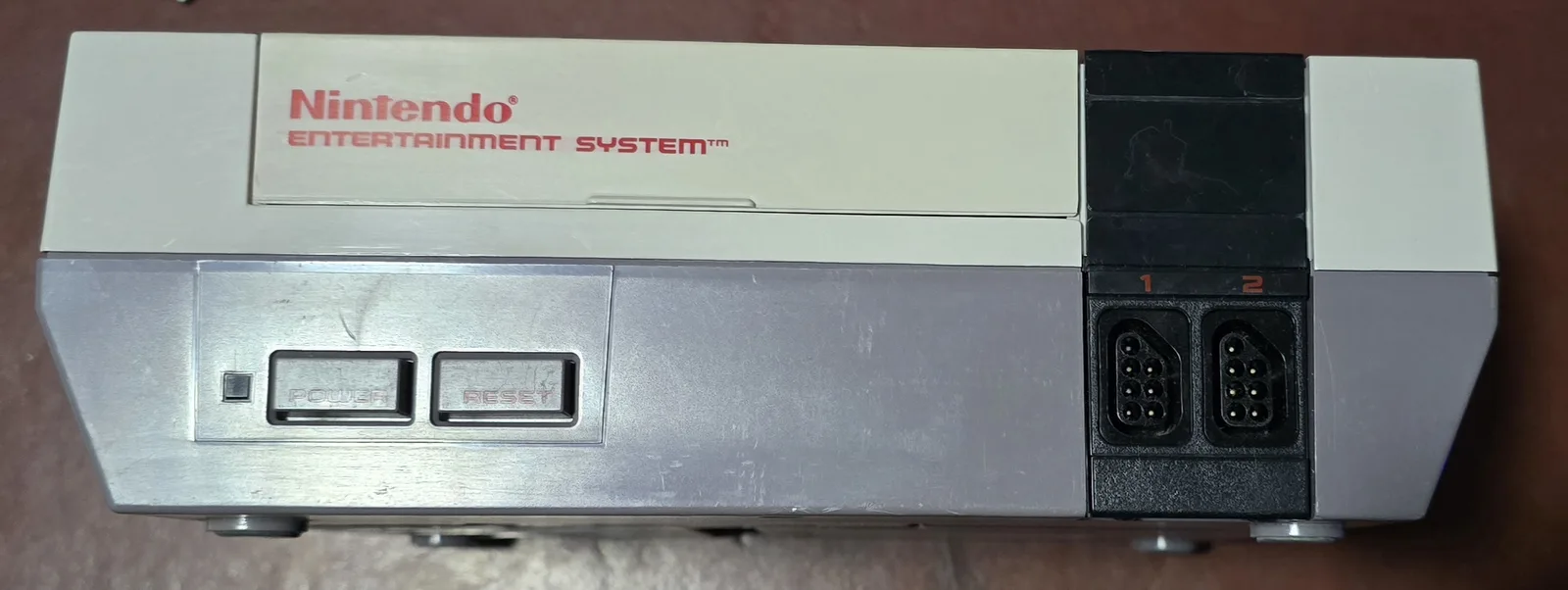
NES Play-Everything Bundle - Restored Front-Loader, HDMI, 2 OEM Controllers, Super Mario Bros. & SD Flash Cart
A restored NES front-loader that plugs straight into your HDMI TV, with an authentic Super Mario Bros./Duck Hunt cart and an SD flash cart that can play nearly the entire NES library, from homebrew to backups of the games you own. One console, photographed as it ships, with free US shipping. Heads up: Duck Hunt needs a Zapper and a CRT, so on this setup it's a piece of history, not a playable game.
$349.00
Adding games or accessories to a bundle? Those add-ons are 20% off, or 35% off when you add three or more.
Everything you need, plugged into the TV you actually own
This is the whole NES in one box, set up for a modern living room. A restored front-loader, two original controllers, an authentic Super Mario Bros. cart, an SD flash cart, and every cable and converter it takes to get from a 1985 console to your HDMI TV, the HDMI cable included. Shipping in the US is free.
Two things to know up front:
- Out of the box, you play Super Mario Bros. The flash cart comes with no games; filling it is up to you (more below, and I’m happy to help).
- Duck Hunt is on the cart, but it needs the Zapper light gun and a CRT television. The Zapper relies on timing that modern TVs and upscalers break, so on this setup Duck Hunt is history on the label, not a game you can play.
Why real hardware instead of an NES Classic? Because this plays actual cartridges: the ones in your parents’ attic, the ones at the flea market, and new games people are still making today, on the original controllers.
What’s in the box
- The console: a restored NES-001 front-loader, serial N11552469, the exact one in the photos.
- The game: an authentic Super Mario Bros./Duck Hunt cartridge on Nintendo’s epoxy-blob board, graded Excellent. Also the exact one pictured.
- The flash cart: an N8 Pro-style SD flash cart with a microSD card, able to play nearly the entire NES library. I sell the same cart on its own as the NES N8 Pro flash cart for $75.
- Two original Nintendo controllers, the exact pair pictured.
- The video chain: a composite-to-SCART cable, the same powered SCART-to-HDMI converter I sell for $50 with its own power adapter (not pictured), and an HDMI cable.
- Power: a new 9V DC adapter for the console. It has two plugs because it also powers a Super NES; only one fits the NES, so you can’t get it wrong. The converter has its own adapter (not pictured). You’ll need two outlets.
A game console disguised as a VCR
In 1985 American retailers had been burned by the video game crash and wanted nothing to do with another console. Nintendo’s answer was to not sell them one. Designers Lance Barr and Don James swapped the Japanese Famicom’s top-loading slot for a front-loading door with a flap so it looked more like a VCR, and the cartridges became “Game Paks” in a “Control Deck.” Nintendo of America’s VP of sales, Bruce Lowry, put the strategy bluntly: “We can’t say anything about it being a video game console.”
It worked. The grey box became one of the most recognizable consoles ever made: the front-loading tray, the flip-up door, the stack-it-under-the-TV shape. A product of its time in the best way.
The controllers fit the plan too. Their cords run about three times the length of the Famicom’s hardwired ones. My read: if the thing is going to live under the TV next to the VCR, the cord has to reach the couch.
The game that sold the NES
Mario’s first job was dodging barrels in Donkey Kong, but Super Mario Bros. is where he became Mario. It came in the box with the NES from 1986, sold more than 40 million copies, and is the game that turned the NES into a household fixture. From 1988 the Action Set paired it with Duck Hunt on this exact combo cartridge, so if your NES came with the Action Set, this was the cart in it.
The pack-in went on to anchor the best-selling video game series in history, over 890 million games according to Guinness, and in 2023 a movie that grossed more than $1.3 billion. Not a bad run for the free game in the box.
Games worth tracking down
Mario gets you started. Here’s what else made the NES what it was, and why each one is still worth a spot on the shelf. The ones I have in stock are linked.
Classics
- Super Mario Bros. (1985): where Mario became Mario.
- Super Mario Bros. 3 (1990): for years the best-selling game that didn’t come in the box with a console.
- The Legend of Zelda (1987): the gold cartridge that showed through a window in the box.
- Zelda II: The Adventure of Link (1988): the side-scrolling, level-grinding black sheep, and the only Zelda with extra lives.
- Metroid (1987): finish faster and you get a better ending. Then there’s the big reveal that the hero is a woman.
- Castlevania (1987): Metroid and Castlevania are where the word “Metroidvania” comes from.
- Mega Man 2 (1989): eight Robot Masters and the E-Tank, the formula the series still uses.
- Contra (1988): the game that made the Konami code famous. Thirty lives instead of three, and you’ll still need them.
- Kirby’s Adventure (1993): Kirby’s first Copy Ability, and the first time he showed up pink.
- Final Fantasy (1990) and Dragon Warrior (1989): where two of the biggest RPG series started in America.
- DuckTales (1989): the Moon theme is famous enough to have a fan following of its own.
- Excitebike (1985): build your own tracks (on a US NES you can’t save them, so finish your masterpiece in one sitting).
- Donkey Kong (1986 on NES): Mario’s debut, back when he was called Jumpman.
- Double Dragon (1988): the beat ’em up that kicked off the genre’s golden age.
- Arkanoid (1987): Taito’s take on Breakout, the block breaker that’s still on your phone almost 40 years later.
Competition
- Tetris (1989): the Classic Tetris World Championship is still played on NES Tetris.
- Dr. Mario (1990): head-to-head two-player, and it sold 2.5 million copies in North America in six weeks.
- Tecmo Bowl (1989): the first console game with real NFL players, and Bo Jackson is basically a cheat code.
Speedrunning
- Super Mario Bros.: the world record is under 4 minutes 55 seconds, two frames off a perfect computer-assisted run.
- Mike Tyson’s Punch-Out!!, The Legend of Zelda and Ninja Gaiden: each with an active speedrun leaderboard.
Famously hard (or famously bad)
- Kid Icarus (1987): Nintendo Power called its difficulty “unmerciful.”
- Ninja Gaiden (1989): lose to any of the last three bosses and it sends you back to the start of the final act.
- Battletoads (1991): the Turbo Tunnel. That’s all anyone needs to say.
- Teenage Mutant Ninja Turtles (1989): defusing bombs underwater at the dam, against a timer.
- Ghostbusters (1988): legendary for all the wrong reasons. If you know, you know.
Light-gun games like Duck Hunt and Hogan’s Alley need a Zapper and a CRT, so they’re the exception on this setup.
The flash cart: homebrew, and the games you own
The flash cart is a clone of the Krikzz EverDrive N8 Pro. It loads NES game files from the microSD card and plays nearly the entire NES library, plus homebrew. Being a clone, it runs unofficial firmware: don’t install official EverDrive updates on it, which can brick it. It’s also weaker than the genuine cart on Famicom expansion audio, the Famicom Disk System and a few exotic mappers. If you need those, the genuine Krikzz N8 Pro (around $200) is the upgrade, and the standalone listing has the full comparison.
It comes with no games, and I don’t sell them. What it opens up:
- New NES games. People are still making them. The NESdev Compo has run for more than a decade, and studios still release new NES games like Micro Mages and Project Blue.
- Backups of games you own. Dump your own carts and play them from one cartridge, with the originals safe on the shelf.
- Fan translations and ROM hacks, applied to your own copies.
New to this? You’ll need a computer that can read a microSD card (a cheap USB reader does it). If you’d like a starting point, message me and I’ll point you at free homebrew to begin with. Two good first loads, both free and open source: Allpads, which shows every button press on your controllers live, and the 240p Test Suite, the standard set of picture tests for retro video.
There’s no such thing as a legal “every game on one cart” NES multicart. Every 500-in-1 out there is a chip full of pirated ROMs. A flash cart is the legal version of the same wish: the hardware is legal, and what goes on it is up to you.
What “Play-Everything” means
Every US NES cartridge you own boots on this console, licensed or not, and the flash cart covers homebrew and your backups. A few exceptions worth knowing: Famicom carts need a 60-to-72-pin adapter, PAL carts boot but may run fast or glitch on a US console, the famous Nintendo World Championships 1990 cart won’t run with the lockout disabled, and some unlicensed carts with a “stun” circuit (certain Camerica and Color Dreams titles) can run hot on a console with the lockout disabled, so don’t leave those running for hours.
The restoration
- The 72-pin connector is the real cause of the blinking light: dirty or worn contacts. This console keeps its original Nintendo connector, cleaned, serviced and tested, and it loads the normal way: insert, press down, power on. With careful restoration the original can almost always be saved, and a restored original beats the cheap reproduction connectors, which grip carts so hard they wear the edge contacts. (There are good premium replacements too; they’re just rarely needed.)
- The CIC lockout is disabled. The 10NES chip is socketed with pin 4 lifted, so a slightly dirty cart won’t throw the console into a blinking reset loop, and unlicensed carts boot. It’s reversible, and the original chip stays in the console.
- Fully cleaned inside and out, then reassembled and checked on composite and RF video with audio, both controller ports, reset, the power switch, and a closed-case soak with an original cart.
- The controllers were taken apart, cleaned, and played for hours across both until I was sure every button and the D-pad respond perfectly.
You can stop blowing in the cartridges, by the way. Nintendo’s own support page says not to blow on the contacts. Reseating the cart is almost certainly what made the second try work.
Condition
- Console: Good. Light yellowing on the cartridge door and the top rear, nothing blotchy, but concentrated enough in those spots that my scale calls it uneven. A 40-year-old grey NES with no yellowing at all is close to a unicorn without retrobriting, which I don’t do. The bottom expansion cover is still in place, which many consoles have lost. The AC adapter / RF switch label on the back is worn but present.
- Cart: Excellent. Graded on my condition scale.
- Controllers: Looks Good, Play Near Mint. Original 1980s plastic, so some yellowing and a few scratches or marks on the shells, as the photos show. I picked this pair because after hours of play across both, every button and the D-pad register every time and feel exactly right.
The picture
The NES puts out RF and composite video, and no RGB. This bundle runs composite into a SCART-to-HDMI converter at 720p or 1080p for a clean, stable picture on a modern TV, a big step up from the fuzzy RF hookup. The SCART cable still carries composite; it’s just the connector the converter takes. The comparison photo (shot on a Super NES) shows RF, then composite and RGB through the same model of converter this bundle includes. The middle picture, composite, is what you’ll get: on an NES it’s as good as it gets without modifying the console.
It’s not a RetroTINK or an OSSC, the enthusiast scalers that cost several times as much, but it’s the best I’ve found in its price class: great for sitting down with Mario and fine for general play, not a frame-perfect competition setup. Put your TV in Game mode to keep the lag down.
It also outlives this bundle. There’s a SCART cable for almost every retro console, so the same box works with whatever you hook up next; I use mine with an NES, Genesis, Super NES, N64, GameCube and Wii.
Built and tested as a system
The console, cart, flash cart, controllers, converter and cables were all tested together before the listing went up. If anything arrives dead or not as described, my returns policy covers you for 30 days from delivery. The setup guide walks through every cable.
Specifications
| Console | Restored NES-001 front-loader, serial N11552469, the exact unit pictured. Original 72-pin connector cleaned, serviced and tested; normal push-down loading. CIC lockout disabled (10NES chip socketed, pin 4 lifted, reversible). Condition: Good (light yellowing concentrated on the door and top rear, nothing blotchy; bottom cover present; AC/RF label worn but present) |
|---|---|
| Controllers | Two original Nintendo controllers, the exact pair pictured, cleaned and play-tested for hours. Looks: Good (yellowing and marks on the shells). Play: Near Mint |
| Flash Cart | N8 Pro-style SD flash cart (a tested clone of the Krikzz EverDrive N8 Pro, not genuine; unofficial firmware, do not install official updates) with a microSD card. No games included |
| Game | Authentic Super Mario Bros./Duck Hunt cartridge (epoxy-blob board), Excellent, the exact cart pictured. Duck Hunt needs a Zapper and a CRT, neither included |
| Power | New DC power adapter for the console; I scope-check every batch and model of adapter I use for clean, steady output. The console and the converter each need an outlet |
| Video | Composite-to-SCART cable, powered SCART-to-HDMI converter (720p/1080p) with its own power adapter, and an HDMI cable |
Similar items
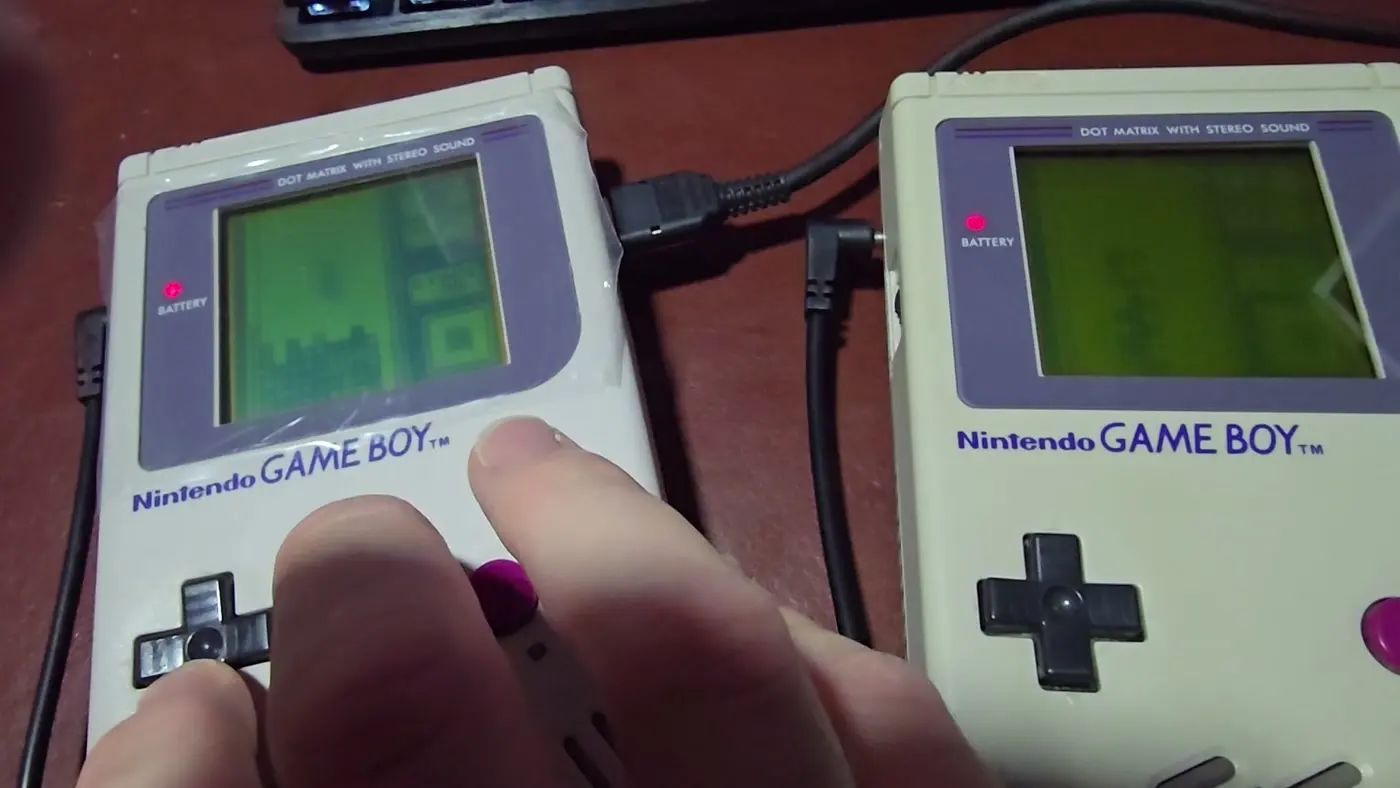
Game Boy Head-to-Head Bundle - Two Restored DMG-01s, Tetris, Link Cable & Flash Cart
Two restored original Game Boys, a genuine Nintendo link cable, and Tetris. The exact setup Nintendo built the link cable for in 1989, assembled and tested as a pair.
$350.00
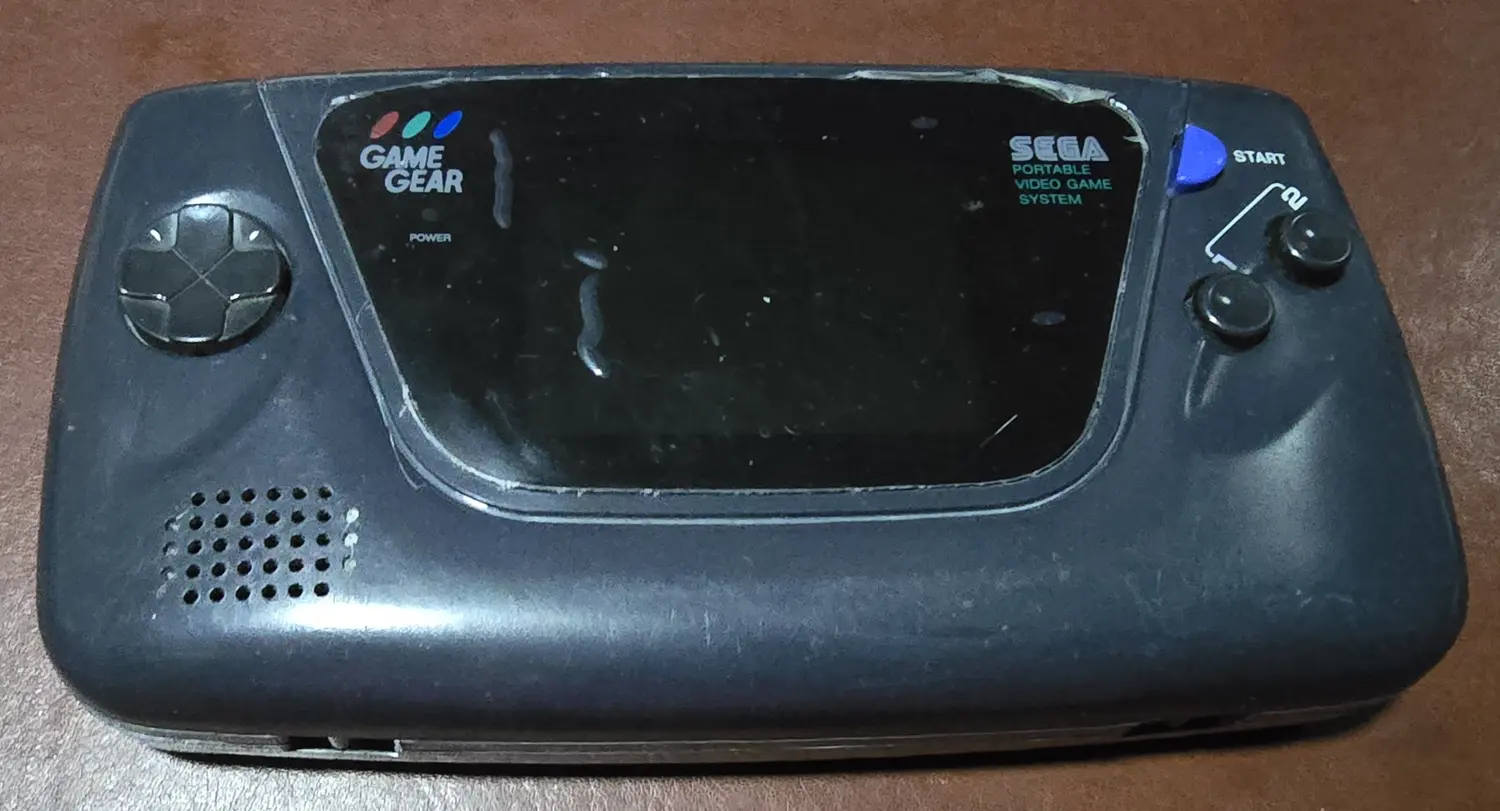
Game Gear IPS + Built-in USB-C - Modded Sega Game Gear with Flash Cart
One specific Game Gear, serial 031143350: a bright IPS panel, a USB-C port where the barrel jack used to be, and a flash cart with the whole library on it.
$230.00
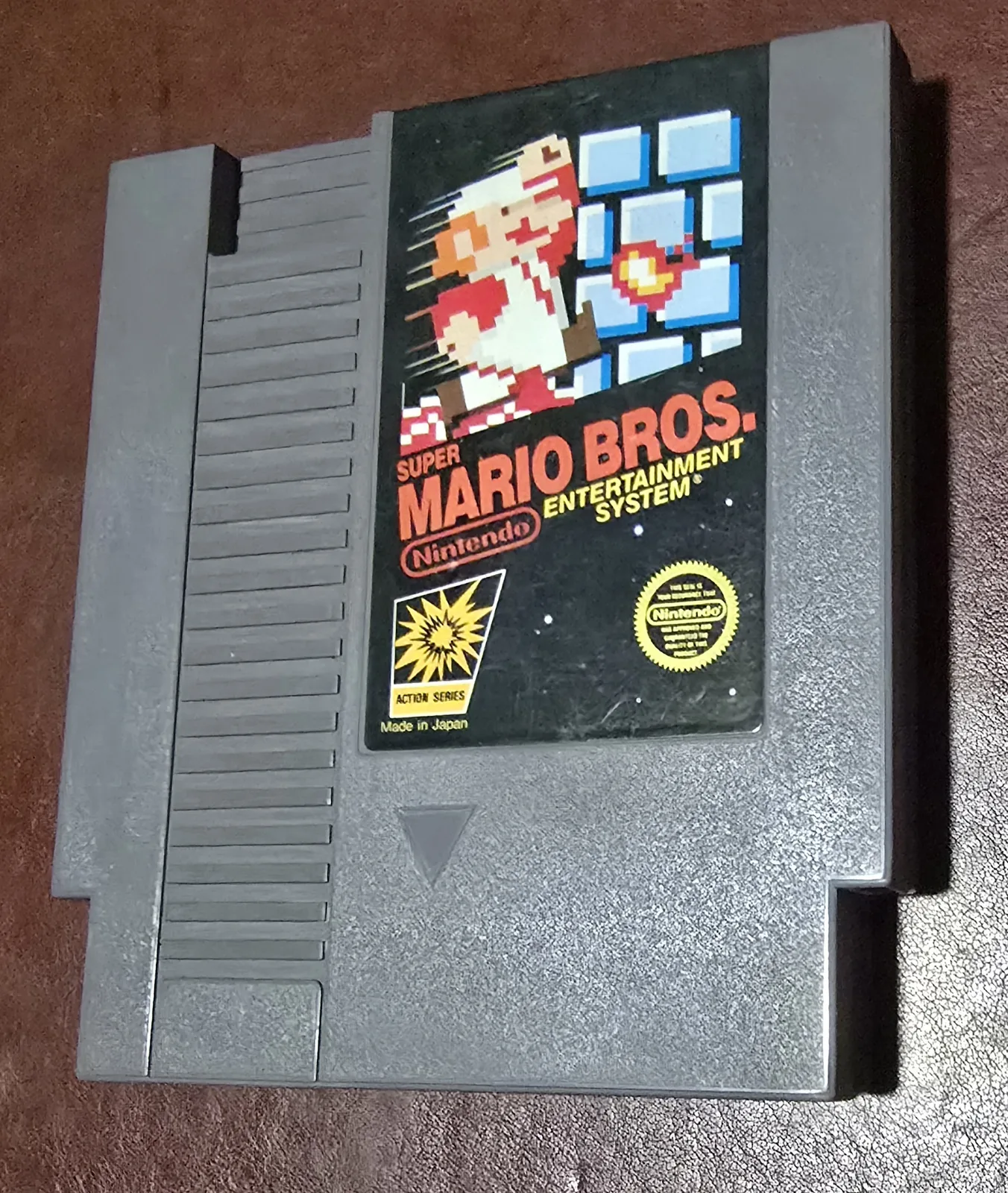
Super Mario Bros. (NES) - Early 5-Screw Standalone Cartridge, Authentic Nintendo
The standalone Super Mario Bros. in the early five-screw shell Nintendo used until about 1988, black box Action Series label and original screws. Graded for condition.
$50.00 - $60.00
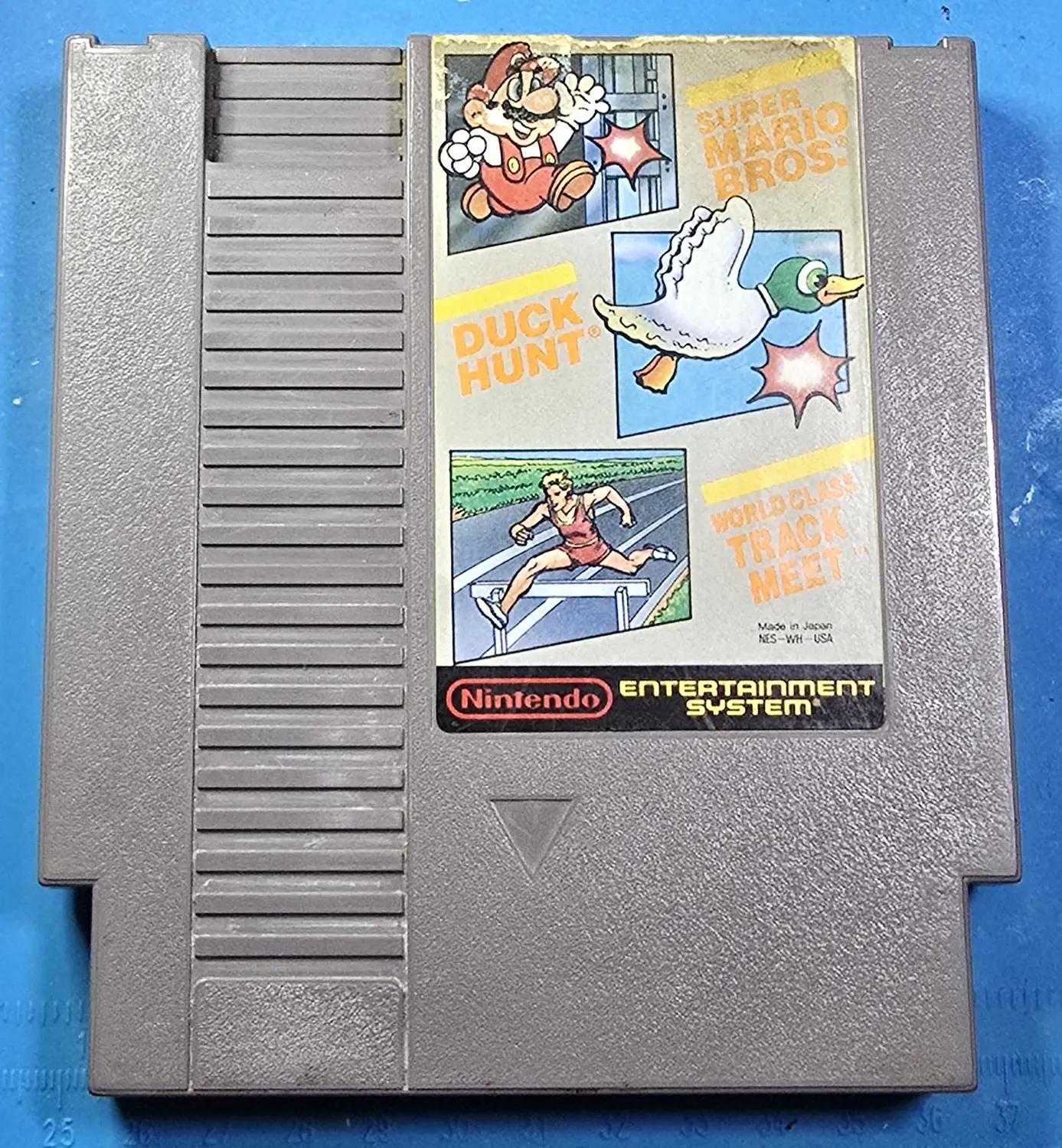
Super Mario Bros. / Duck Hunt / World Class Track Meet (NES) - Authentic Nintendo 3-in-1 Cartridge, Tested & Cleaned
The NES Power Set pack-in: three games on one authentic cart. Tested and cleaned, pick your condition grade. Heads up: Duck Hunt needs a Zapper and a CRT/tube TV, and Track Meet needs a Power Pad mat. Super Mario Bros. plays on any TV.
$17.00